Veesie: measuring whether AI mentions your brand, every week, with the noise taken out
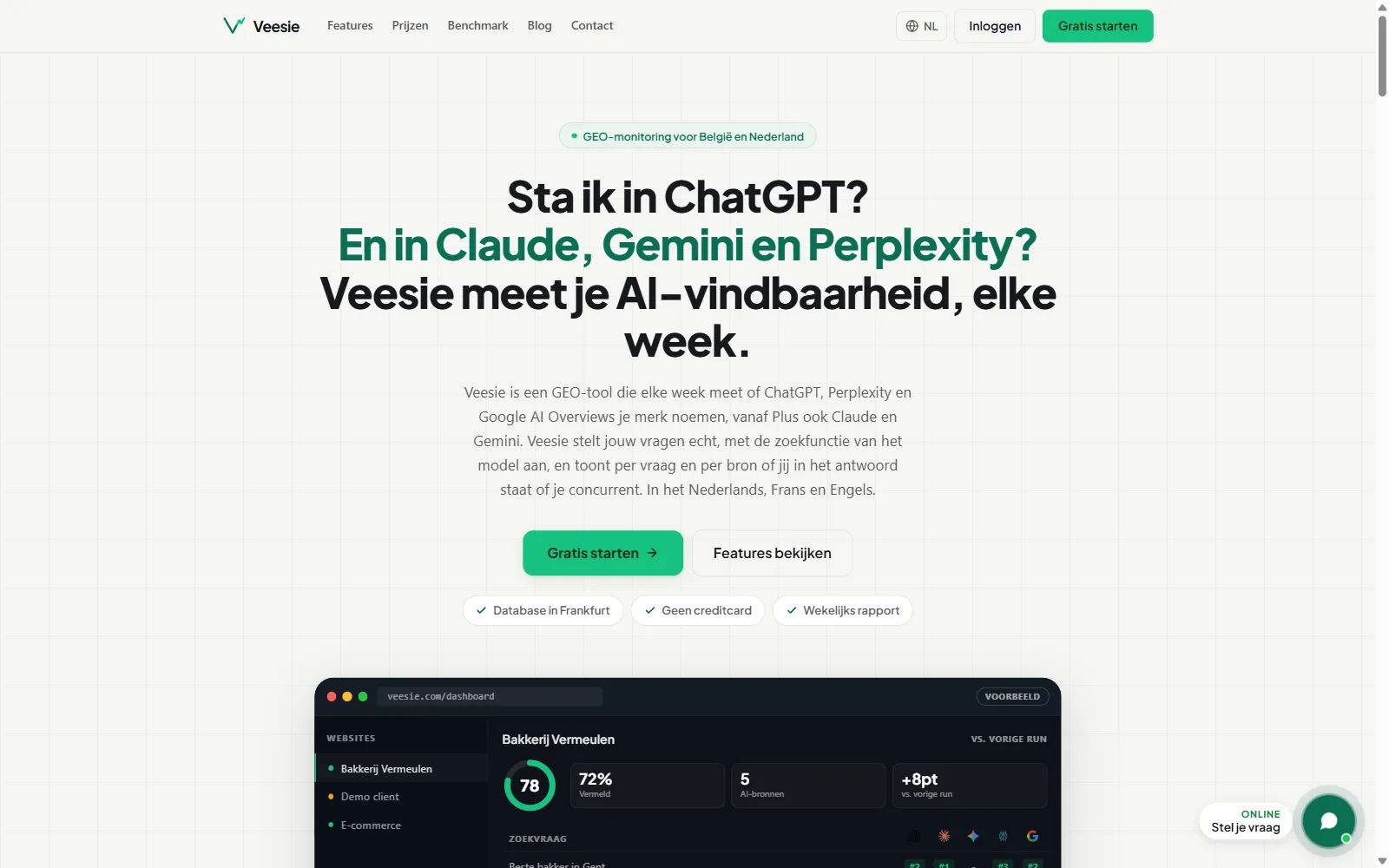
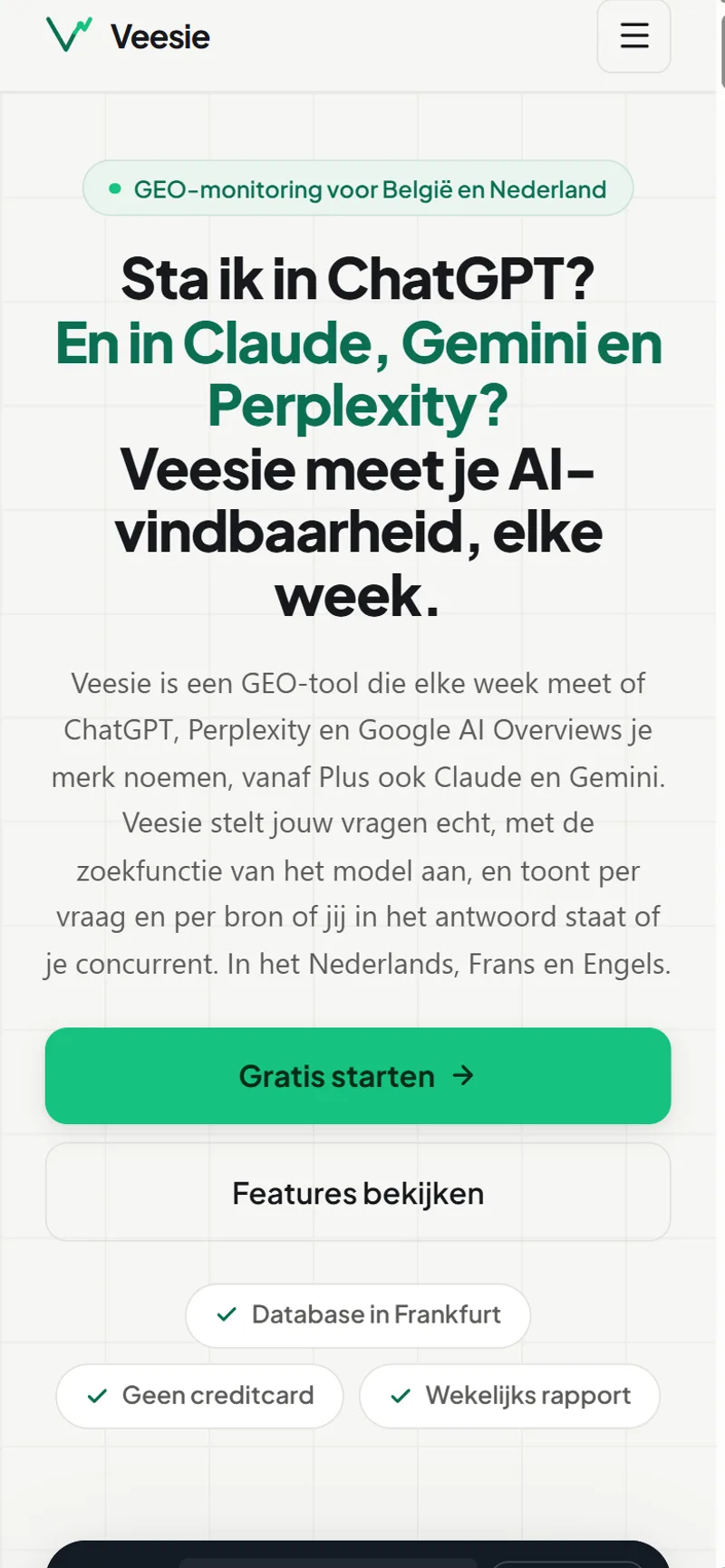
Veesie is a SaaS brand of our own that we built from scratch. It asks ChatGPT, Claude, Gemini, Perplexity and Google AI Overviews the questions your customers ask, with the model's search function switched on, and counts who appears in the answer. Every week, in Dutch, French and English, and set up so that one chance answer does not decide your figure.
Ask an AI assistant the same thing twice and you get two answers. Measure that without repetition and you are measuring chance.
Challenge
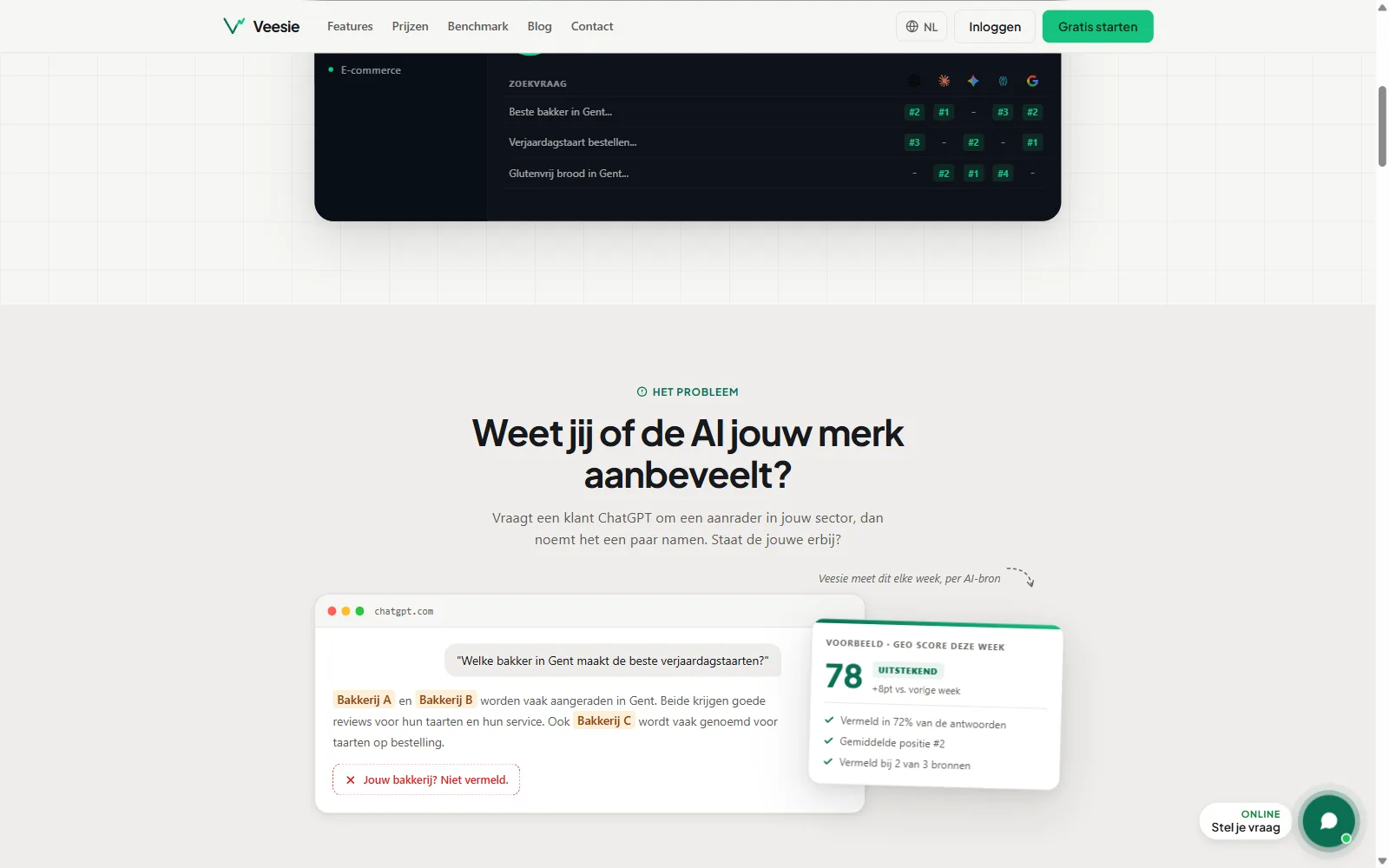
More and more customers ask an AI assistant for a recommendation instead of scrolling through ten blue links. So a business wants to know whether it appears in those answers, next to whom, and whether that is improving. The catch: an AI answer differs per attempt, per model and per language, which makes a snapshot worth very little. The question was whether you can turn that into a figure that means something, and do it again every week.
Approach
Real questions, asked live with the model's search function on, across five sources. Repetition where the models vary most, a fixed basket of three sources for the score so your line does not jump, and everything that needs no judgement in code. Built with Claude Code, and guarded by a test suite that grew with every feature: 521 test files at the time of this case.
5
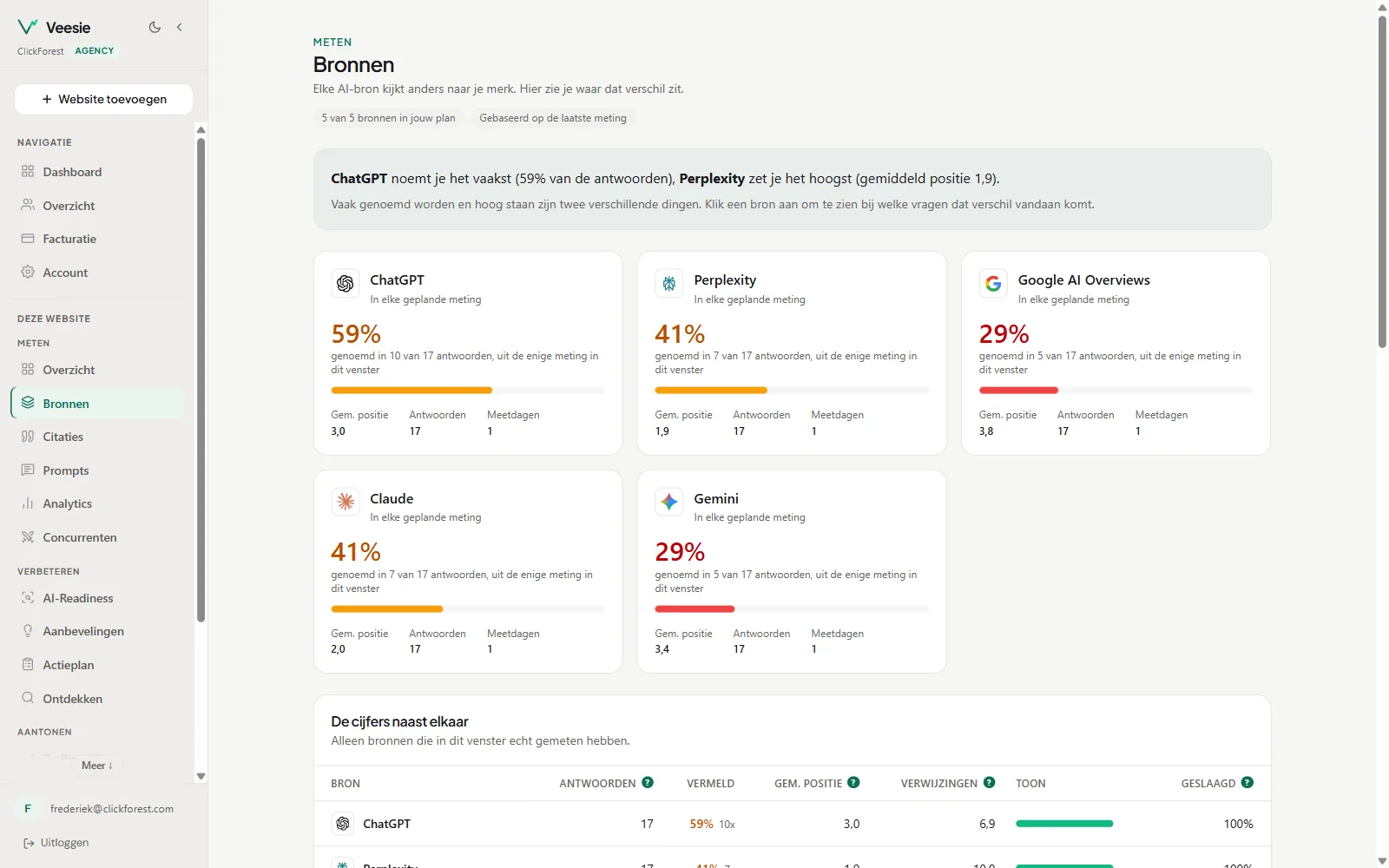
AI sources per question: ChatGPT, Claude, Gemini, Perplexity and Google AI Overviews
4 points
between the highest and the lowest of five identical measurements on one day (25 August 2026, 12 questions): 85, 87, 84, 88 and 85
0
missed mentions when reading 655 answers (test of 24/08/2026)
521
test files in the repo, with the prices, plan limits and chatbot knowledge as guarded facts
Real questions, with search switched on
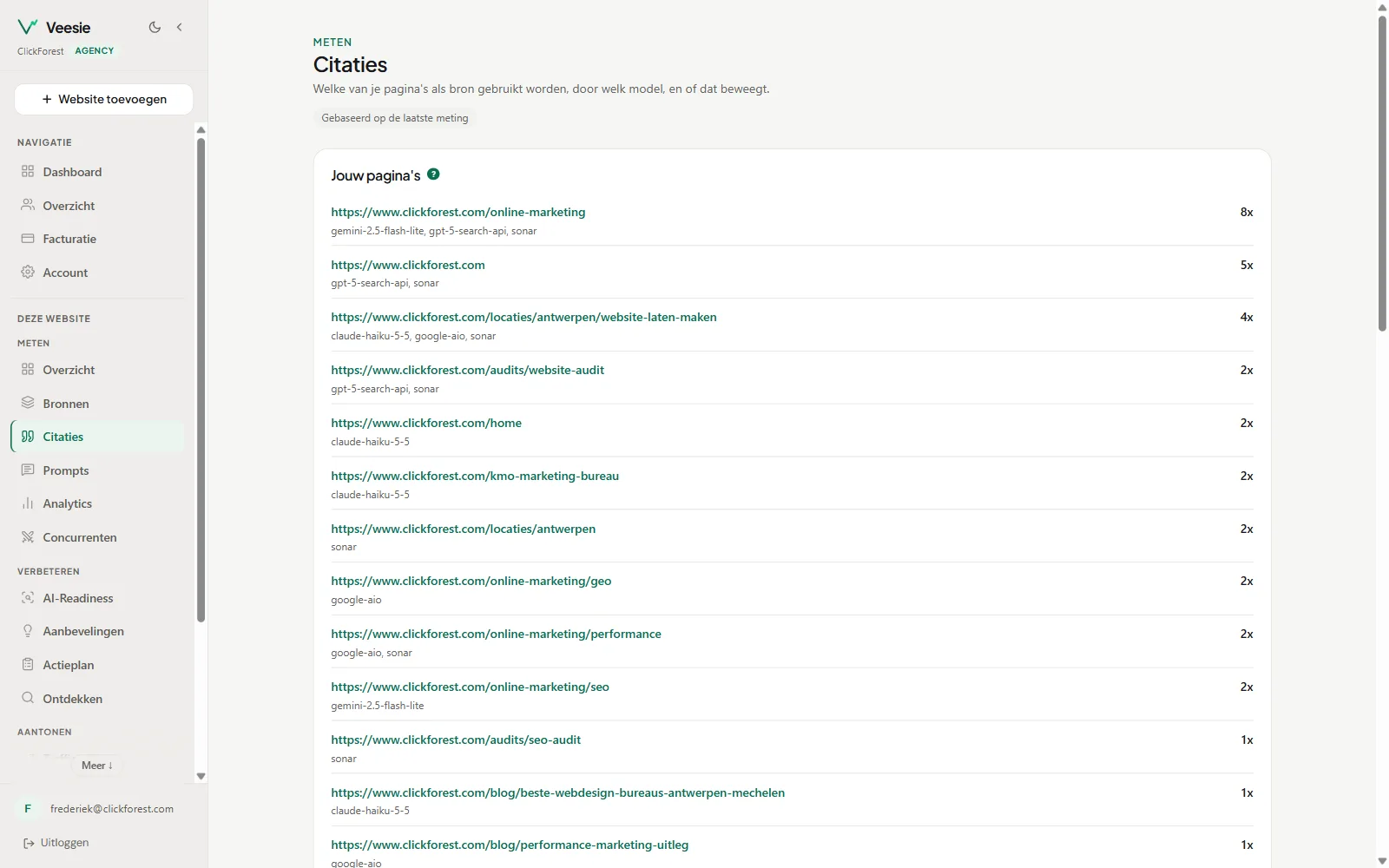
Every question goes live to the source, with search switched on: gpt-5-search-api for ChatGPT, sonar for Perplexity, Claude Haiku 5.5 and Gemini 2.5 Flash-Lite with web search, and Google AI Overviews straight from the real Google results through DataForSEO. When the model cites sources, Veesie stores them with the answer, as a clickable link. So you see not only whether you are mentioned, but also which pages the AI read to get there.
For every answer, Veesie records whether the brand is mentioned, in which position, in what context and with what sentiment. The extraction was tested on 655 answers over seven days: zero missed mentions that were literally in the text, zero mentions without grounds.
One measurement is noise, five show the pattern
On 25 August 2026, Veesie ran five identical measurements on clickforest.com: 12 questions, five sources, within one hour, with the models of the time (Claude Haiku 4.5; since 8 October 2026 Veesie measures with Haiku 5.5). The score stayed stable: 85, 87, 84, 88 and 85. Underneath, plenty changed. In 14 of the 60 combinations of question and source, the answer came out differently from one run to the next, and 10 of those 14 came from Claude and Gemini.
Five identical measurements on clickforest.com, 25 August 2026, 12 questions.
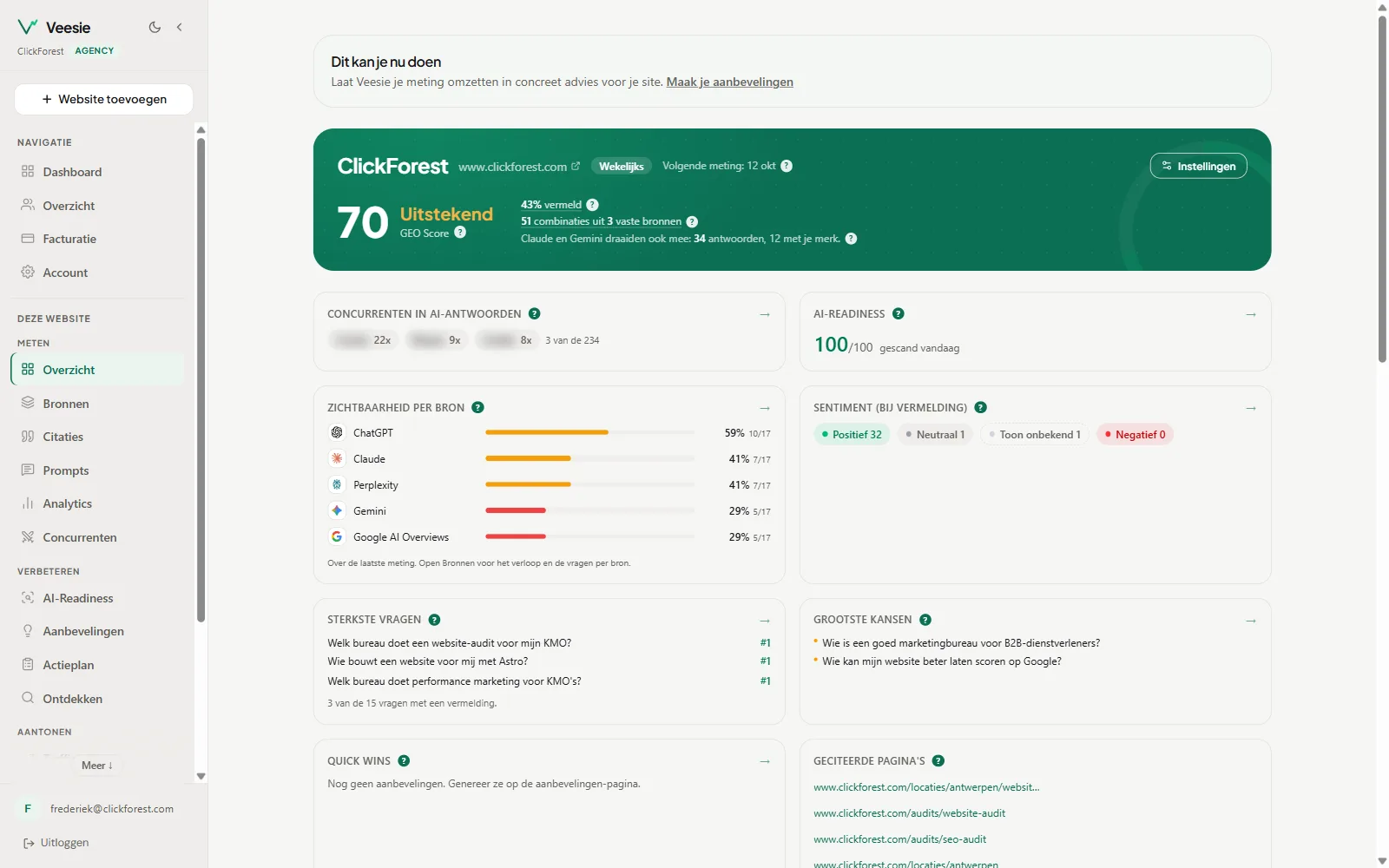
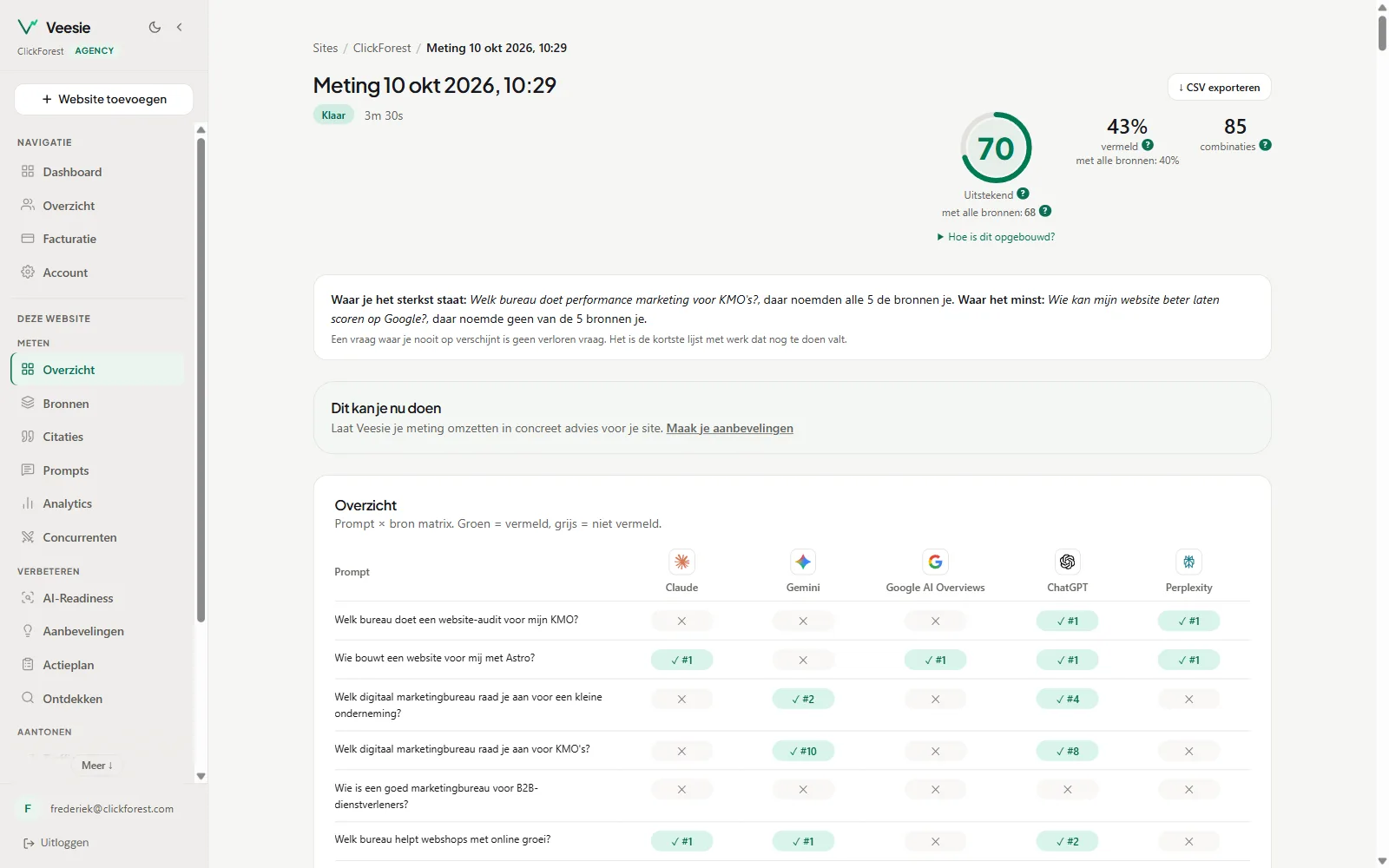
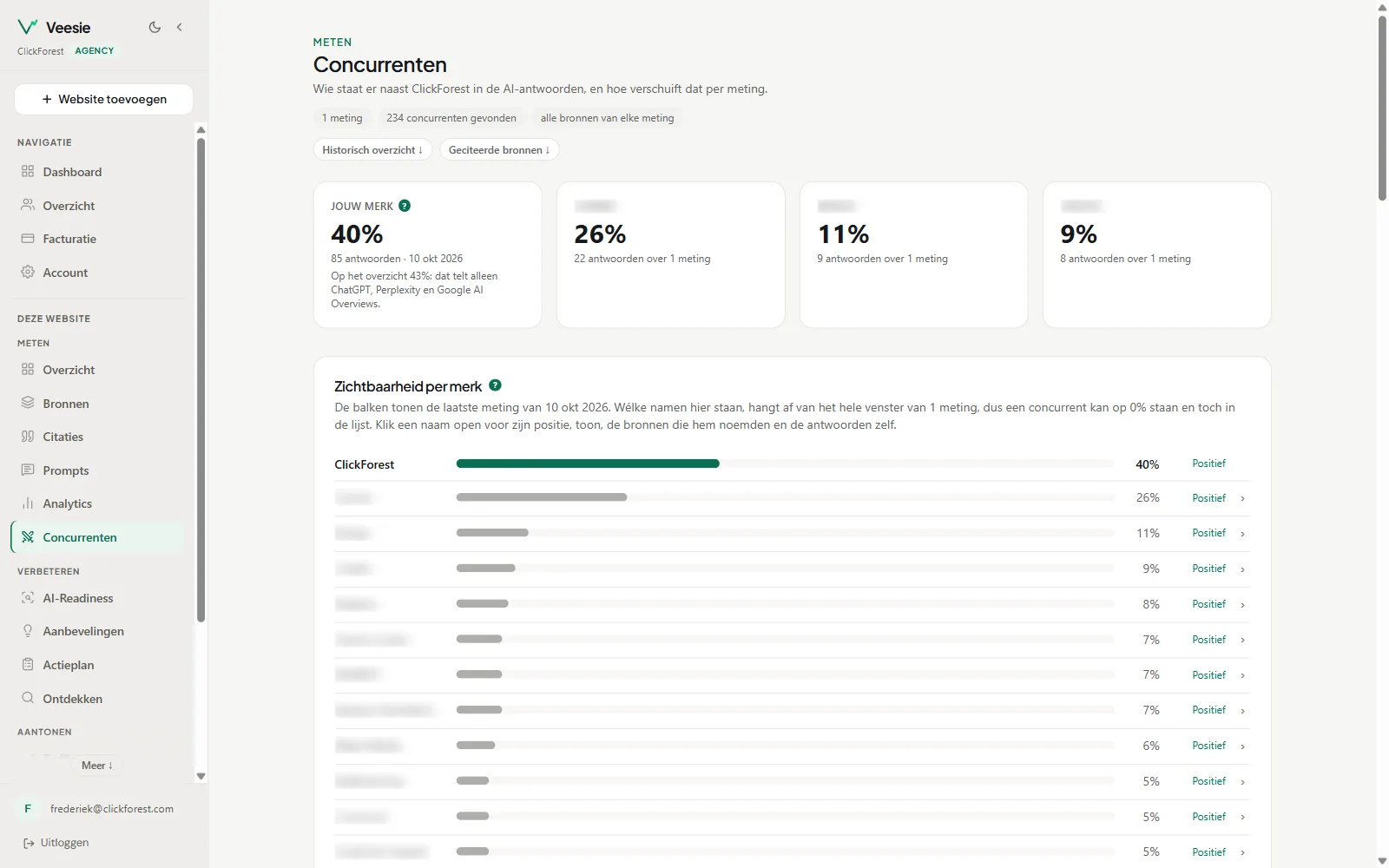
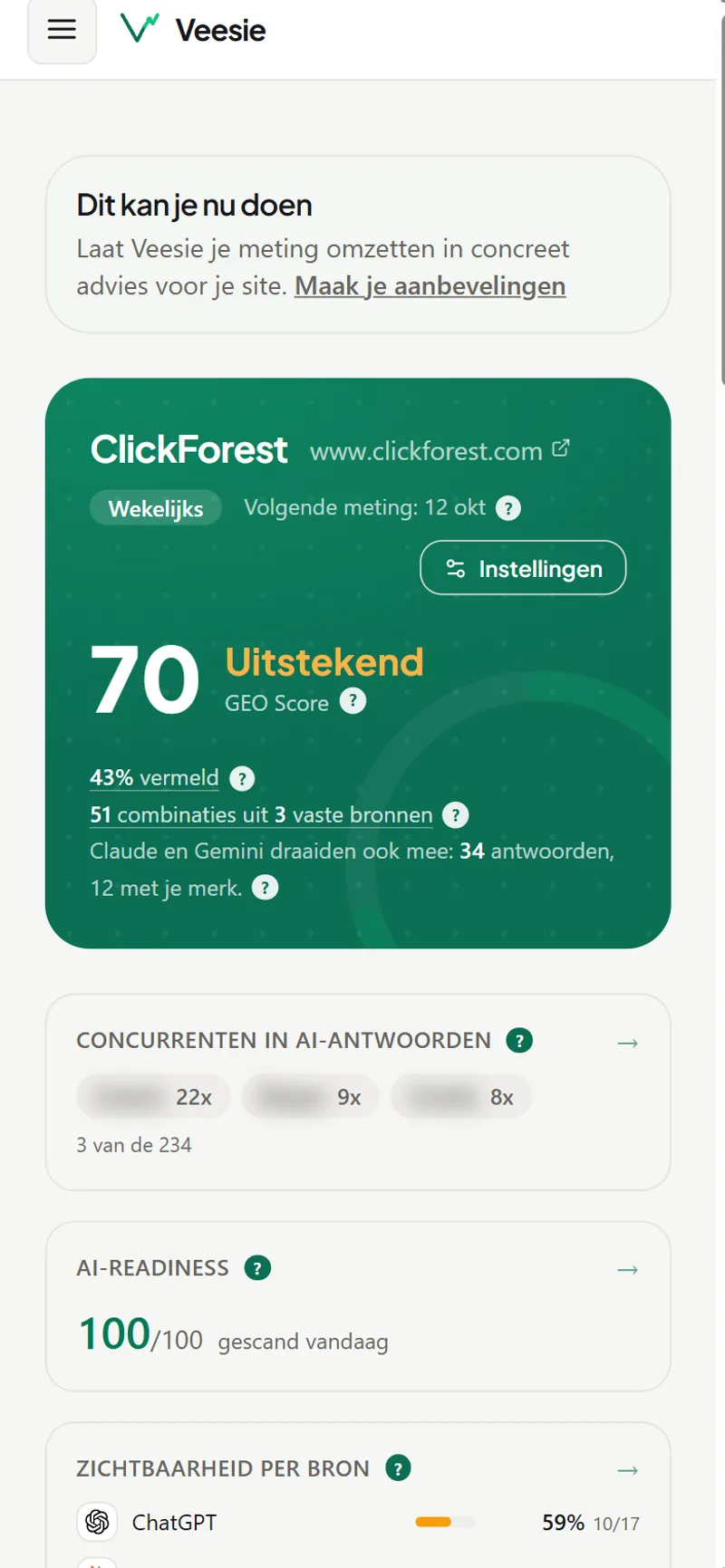
That test is about how stable the figure is for the same questions, not about the level. The dashboard in the gallery shows a new measurement from 10 October 2026 on 17 different questions, which Veesie derived from the site, and there clickforest.com scores 70. A different question set gives a different level.
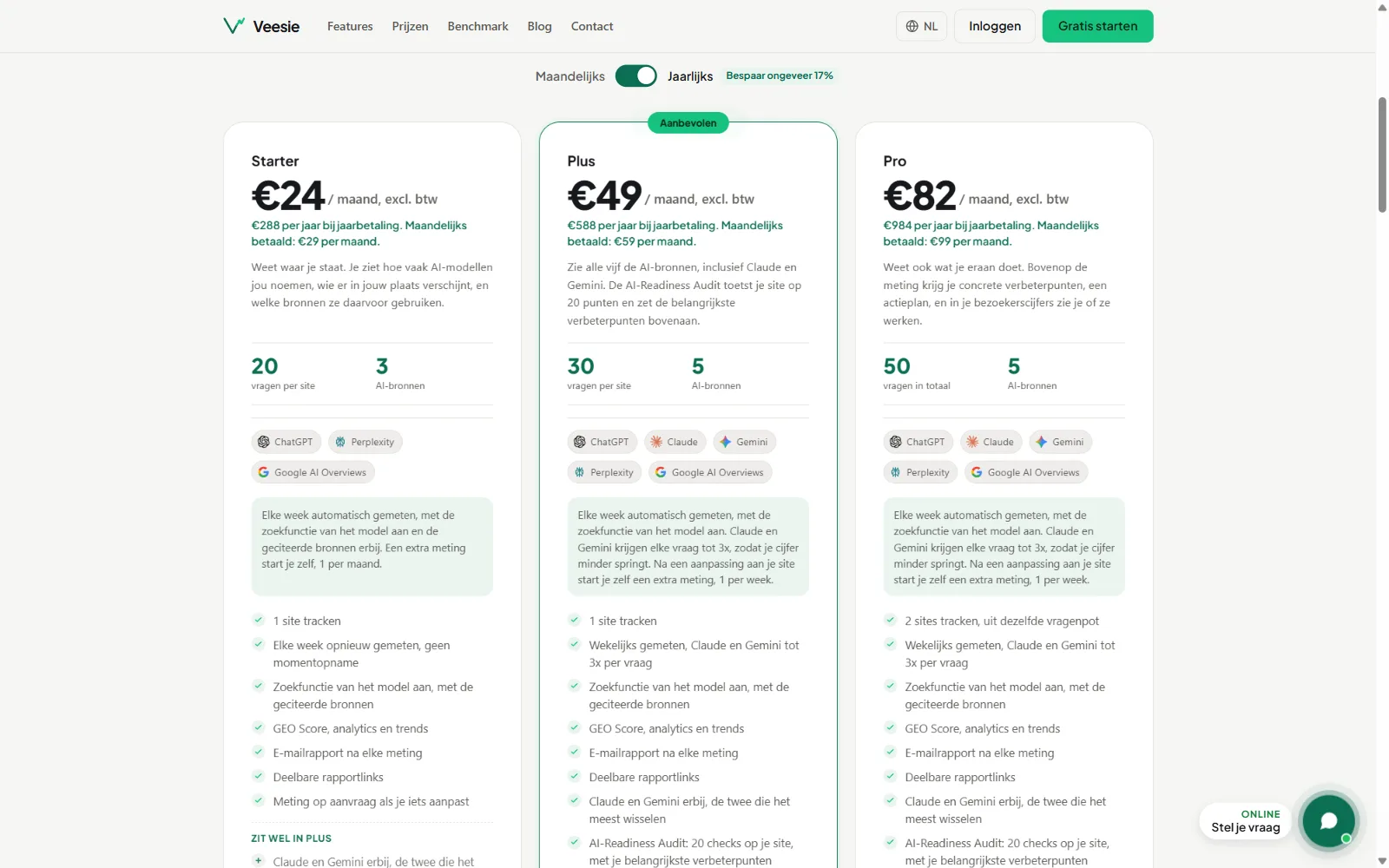
Two design choices followed from this. Claude and Gemini get every question up to three times, and Veesie keeps the majority. And weekly became the maximum on every plan: measuring more often barely changes the figure, what does change is your site. For that there is an extra measurement on request, after a change.
A score that does not jump
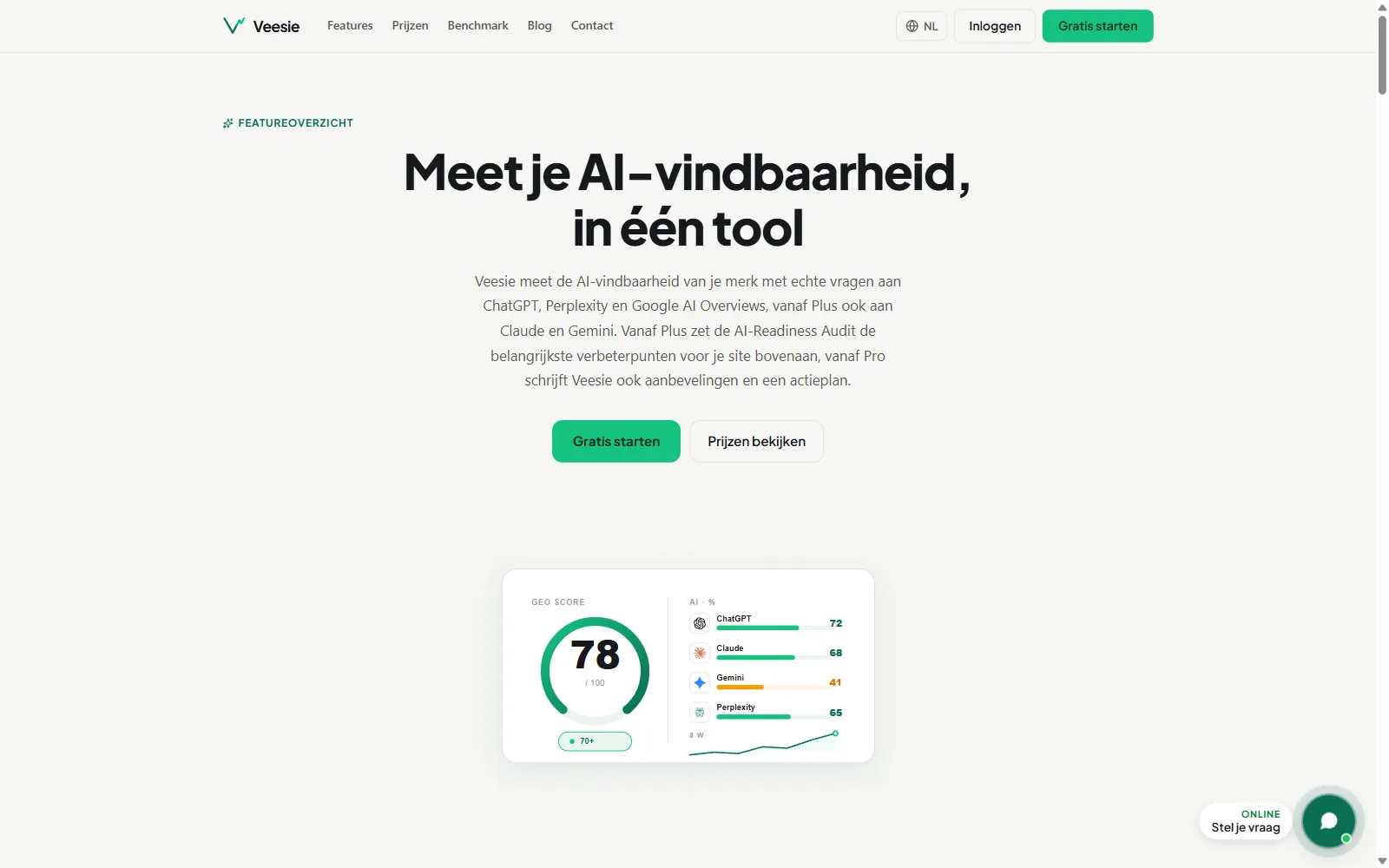
The GEO Score is an index of our own from 0 to 100, which is why the formula is public (veesie.com/features): 50% mention rate, 25% sentiment, 15% source coverage and 10% position in the answer. On every plan the score is calculated over the same three sources: ChatGPT, Perplexity and Google AI Overviews. Claude and Gemini are measured and shown from Plus, but do not count. Anyone who changes plan therefore does not see their line jump because of a different basket.
50251510
Mention rate 50%
Sentiment 25%
Source coverage 15%
Position 10%
From measurement to advice
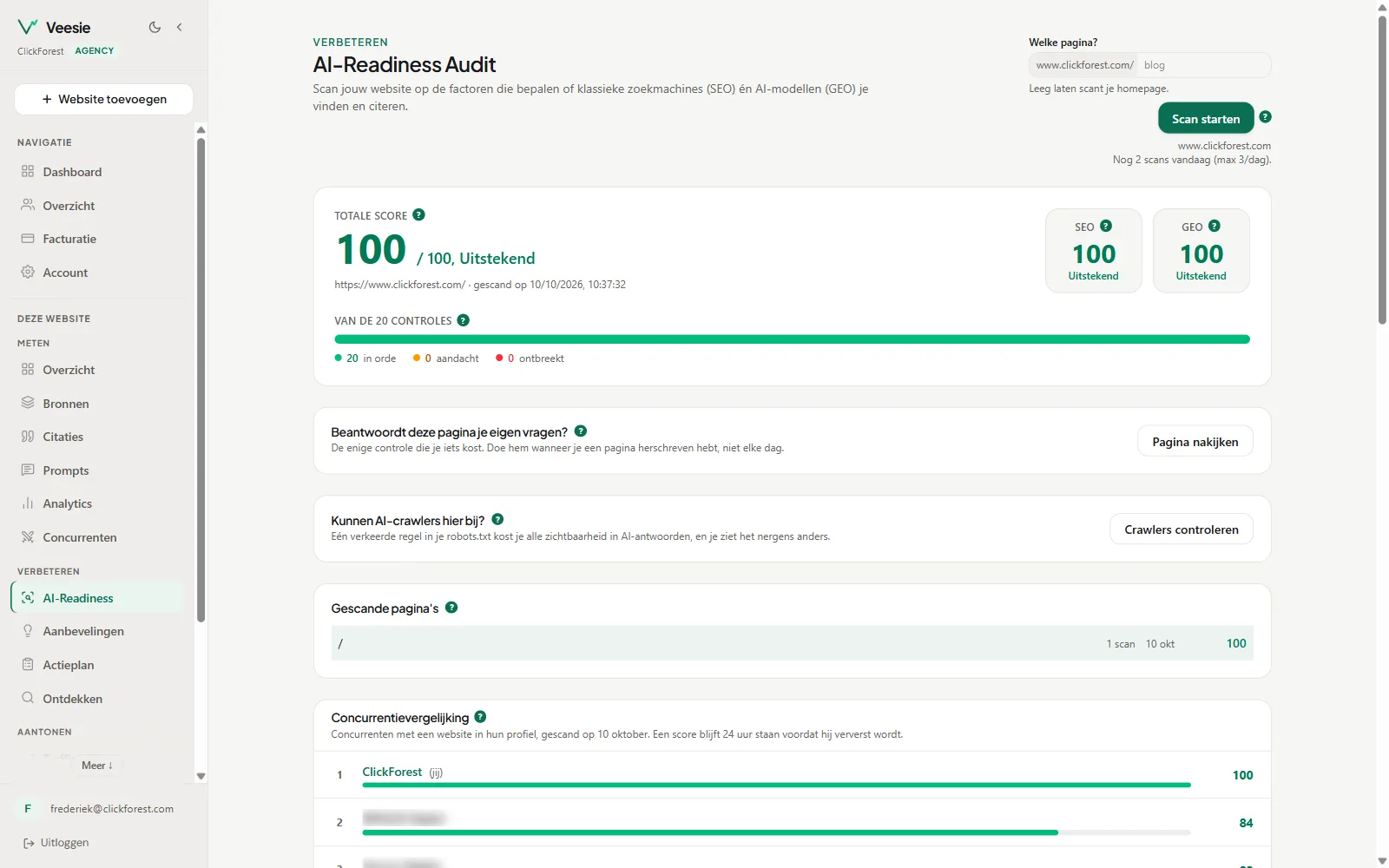
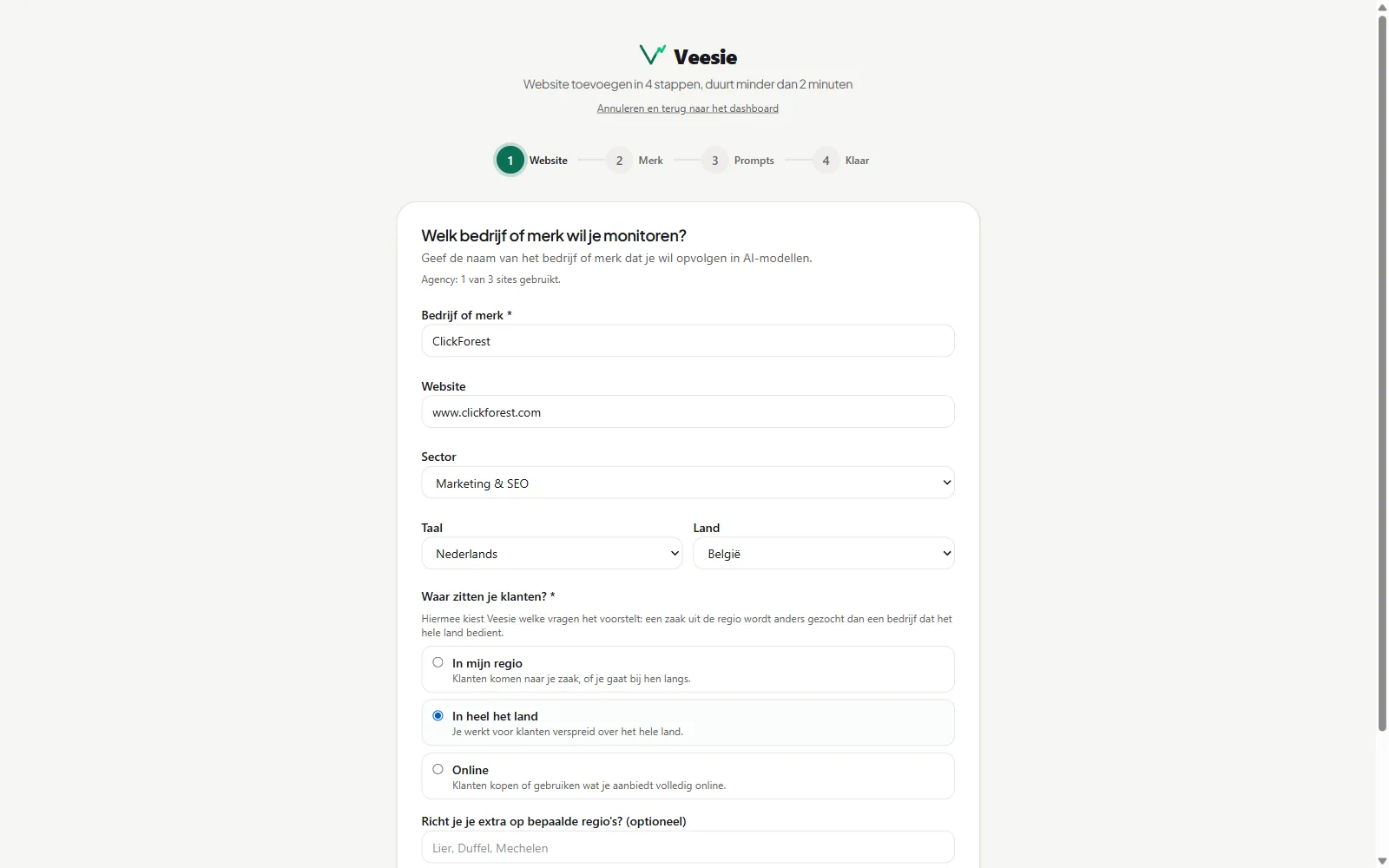
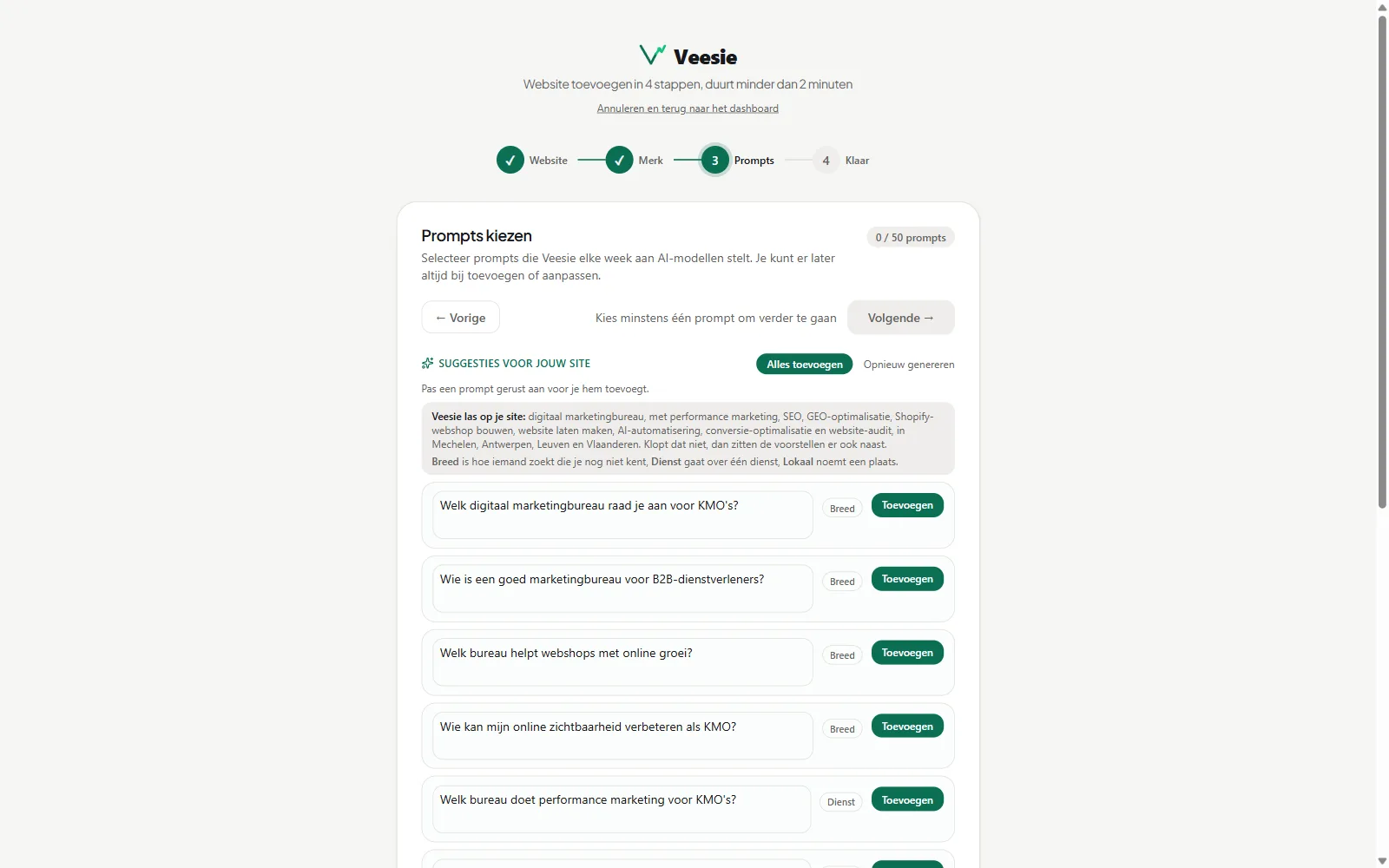
Measuring is half the job. When you add a website, Veesie reads the site itself and suggests questions of three kinds: broad, per service and local. From Plus, the AI-Readiness Audit checks the site on 20 checks, ten for SEO and ten for GEO, and puts the most important improvements at the top. From Pro, Veesie writes GEO Recommendations based on the last five measurements, puts them in an action plan, and the GA4 connection shows in your own visitor figures how much traffic AI brings in. That connection reads Google Analytics with the scope analytics.readonly, verified by Google on 24 August 2026.
Veesie was built with Claude Code, from the first commit on 25 April 2026 to the public launch in October: 1,927 commits and 100 database migrations. What makes it reliable is the test suite underneath. Besides the measurement logic, it also checks the facts visitors read. Prices and plan limits come from one configuration file, and tests fail when a text or the chatbot promises a feature the plan does not have, or names a number that is no longer correct. A chatbot that does not know a feature does not say "I don't know". It answers just as confidently from what it does have. So its knowledge gets tested too.
A GEO tool has to be cited correctly itself
A tool that measures AI visibility is itself described by AI. On 9 October 2026, an AI assistant showed Veesie in a comparison with the wrong logo and quoted the yearly price as the monthly price. The cause was probably on our own site: a schema markup that described two brands as one entity, and a pricing page that showed the yearly price large without saying so. The same day there were citable sentences per plan, FAQs on exactly those misunderstandings, a corrected schema and an IndexNow ping for all 69 pages. Tests make sure it does not come back.
What it costs to run
Veesie runs the cheapest model per family, with search switched on. With web search, the search layer shapes the answer more than the size of the model, and that makes a weekly measurement possible from €29 a month. The cost per measurement is not estimated but calculated from real measurements and the rates per model, and checked again at every model change. The measurements themselves run through Inngest, with a separate step per combination of question and source, so a measurement of 85 combinations does not run into the time limit of a single Worker.
What we do not claim
No customer results. Veesie has been open to the public since October 2026. Figures on what customers achieved with it will come once they exist.
Not a mirror of the consumer app. Veesie runs the cheapest model per family, with search switched on. Which brand a model names first can differ from what someone sees in the app today. As a relative measure, week after week, the measurement is reliable.
One stability test, on one site. The series 85, 87, 84, 88 and 85 comes from clickforest.com, a brand that gets mentioned often. For a brand that hardly appears anywhere, the figure jumps relatively more: on veesie.com itself, the same kind of measurement went from 0 to 22.
No industry standard. The GEO Score is an index of our own. That is why the formula is on the site, so you know what a rise means.
Veesie itself is hardly mentioned yet. A new brand still has to build that visibility, and Veesie measures that for itself too, every week.
The dashboard is in Dutch for now. Veesie measures questions in Dutch, French and English, but the dashboard itself is currently only available in Dutch.
Five sources, every week
ChatGPT, Claude, Gemini, Perplexity and Google AI Overviews, queried live with search switched on, in Dutch, French and English.
Repetition against noise
Claude and Gemini get every question up to three times. Five identical measurements on one day gave 85, 87, 84, 88 and 85.
Facts that get tested
Prices, plan limits and what the chatbot says come from one source and are guarded by the test suite.
Tools used
Claude Code (building with AI)
Next.js 15 and React 19, through OpenNext on Cloudflare Workers
Supabase (Postgres and Auth) in Frankfurt
Inngest for the measurements, with one step per question and source
OpenAI, Anthropic, Google, Perplexity and DataForSEO as AI sources
Stripe for the subscriptions, Resend for the emails
Cloudflare Turnstile and Sentry
Good to know before you start a free trial: the Veesie dashboard is currently available in Dutch only.
A real recommendation! Frederiek has broad expertise and works extremely professionally. He is genuinely committed to helping us as a client get the most out of our website and digital marketing. He takes the trouble to get to know us as a company and to translate that into our digital visibility, so that it has an impact for us. Very clear communication and a pleasant collaboration.
A really great experience with ClickForest. Right from the start, a clear explanation of how things would work and of where the digital landscape is heading. Clear expertise and very direct, personal contact. Communication went very smoothly, and the transparent quote formed the basis of our collaboration. During the project we noticed how quickly Frederiek can switch gears. Every email and question is followed up in no time, whether by WhatsApp, phone or email. Day after day we saw changes to our shop heading in the right direction. Feedback was followed up and shared with us very quickly. No waiting weeks for an answer, but personal one-to-one contact, always with the same person. That is how it should be!
A satisfied client who is here to stay!
After consulting several website builders, our choice fell on "ClickForest". Not the cheapest, but they proposed a direct and personal approach. Thanks to a good collaboration with Frederiek, our new website "Servaes Services" was launched quickly and efficiently, and we highly recommend them.
Excellent service and a beautiful end result. My website was built professionally, with great attention to detail and user-friendliness. Smooth communication, fast execution and a very pleasant collaboration. Definitely recommended!!!
From the very first conversation I immediately felt a connection with Frederiek. The passion and dedication he puts into his work and projects has genuinely moved me on more than one occasion. He has a wealth of experience and knowledge, and that really comes through! He is also open to dialogue and always stays close to the ball, making every small step feel like a giant leap forward. What impresses me most is his long-term vision. From the very beginning of our collaboration you can feel that he is not just out to deliver work and send an invoice. He thinks ahead with me towards where I want my project to be in one year, three years, five years and beyond. Thank you for all your wonderful work so far, Frederiek, and I hope we can continue to work together successfully for many years to come!
Five years ago I went all-in and made a bold investment. The restaurant was a thing of the past, and the new webshop built by Clickforest became our future. What started as an emergency solution grew into a beautiful, well-running Shopify shop and a collaboration with a reliable, trusted partner I can count on completely. In hindsight, it was a bull's-eye. When corona forced all restaurants to close, I knew immediately: this is going to last longer than three weeks. I refused to give up and decided to look forward. As a chef and restaurant owner I had zero experience with online marketing or SEO, it was completely new to me. But thanks to Frederiek at Clickforest I learnt step by step how it all works. The result? Our sales grow every year. Frederiek keeps coming with new ideas and handy tools to improve the shop further, I just need to put them into practice. Today I enjoy quality of life again. More and more processes are automated, so the webshop runs in the evening while I used to be sweating in the kitchen. I now have a stable, loyal team for many years, and all of that thanks to the single decision to go all-in on the online shop and trust Frederiek blindly. Even today we are still expanding. Our delivery is now split into zones, and Frederiek built that seamlessly into our shop. My ChatGPT has meanwhile been turned into Bastiano's own content studio, yet another smart step forward thanks to him. If I had to give stars, five stars would be far too few. 10/10 mate! Without Frederiek I would never have made it.
Eternal gratitude! Debby Swinnen - Owner - Bastiano
Italian cuisine con tanto amore ❤️
From the very first conversation with Frederiek at Clickforest we knew we were dealing with the right person. His approach is not only well thought-out and strategic, but also surprisingly confrontational, in the most positive sense of the word. He immediately put his finger on pain points we had not even considered ourselves. Frederiek has an impressive and in-depth knowledge of marketing, Shopify, Google and Meta. What truly sets him apart is his ability to seamlessly integrate all these platforms into one powerful whole. Moreover, Frederiek is an extremely pleasant person to work with. He is clear in his communication, thinks along with you, is enthusiastic and at the same time realistic. In short: if you are looking for someone who thinks beyond standard solutions and works towards the best result in a pleasant way, Clickforest is more than the right choice.
ClickForest combines AI, online marketing and e-commerce in a way you simply won't find anywhere else. Thanks to their approach you quickly see tangible results.
ClickForest delivers top results! Professional, innovative and always focused on measurable growth. A real recommendation for anyone who wants to make an impact online.
A very pleasant collaboration with the ClickForest team. They really listen to your wishes, think proactively and deliver quality. Thanks to their expertise we have made great strides online. Absolutely recommended!
One-stop shop for online marketing, e-commerce and AI. Professional agency. Up to date on all the latest developments. Thinks along with the client and is results-oriented.
A marketing, e-commerce and AI advisor who really knows their stuff! Extremely proactive approach and always up to date with the latest trends. Highly recommended!
As a small business owner, SEO always felt like a distraction from my work, but that changed completely when I started working with Frederiek at ClickForest. I am by nature quite sceptical about digital marketing, but Frederiek treated my small business with the same care you would expect from a large corporate client. Instead of leaving me in the dark, he took the time to explain the fundamentals so I could better understand my own website. That transparency genuinely gave me more confidence and a valuable new set of tools. He handled the time difference between the US and Europe very well and was always willing to jump on a call when it suited me. He also worked directly with my web developer to complete the technical and on-page changes without any issues or downtime. Our visibility has increased enormously and I finally feel that I have our organic growth under control. If you are based in the United States and are looking for someone who knows their stuff and genuinely cares about your business, I can wholeheartedly recommend ClickForest.
Clickforest is not just a digital agency. Their advice makes a real difference. Every recommendation feels tailored, actionable and based on genuine experience. They do not simply push generic marketing tactics; they take the time to understand your goals and give you clear, structured guidance that actually delivers results. The team's knowledge and strategic thinking have saved me time, money and a great deal of trial and error. If you are looking for a partner who delivers real value instead of empty buzzwords, I wholeheartedly recommend Clickforest.
The most important part of a successful and profitable webshop is a team that understands your needs and ambitions. With ClickForest you have a dedicated team of experts that helps you refine the how and why, maps out your strategy together with you and combines this with impressive results.
ClickForest combines digital efficiency, innovation and human values: the ideal agency to accelerate the growth of your business while remaining true to your needs and goals.
Thanks to the tips from ClickForest on using the right AI tools, my productivity has increased enormously. The tips are tailored and explained in plain language. I simply cannot do without them anymore! My follow-up questions were also answered quickly and specifically. Many thanks!
These clients also rated ClickForest 5 stars on Google