What does a website cost? From build price to total cost
What does a website cost? There is no fixed price: the cost depends on scope, platform and the total cost over three years


Summary
- There is no fixed price for building a website: the cost is a function of scope, not a single number
- The total cost over three years weighs more heavily than the one-off build price: hosting, maintenance, security and licences add up every year
- The platform is the biggest TCO lever: WordPress, a static site on Astro, a website builder and Shopify each have a different cost profile
- Security as a hidden cost: 91% of WordPress vulnerabilities sit in plugins, with 11,334 new reports in 2025 (Patchstack)
- Cheap can turn out expensive: 46.1% of visitors judge credibility on visual design, which costs weak sites leads (Stanford)
- A website is an investment: a 0.1 second faster load time delivers 8.4% more conversions in retail (Deloitte for Google)
What does a website cost? The honest answer is that there is no fixed amount. A price without a defined scope says little, because the same question covers both a simple one-pager and a multilingual business website with a blog, lead management and integrations. Anyone comparing quotes on a single figure is comparing apples to oranges.
More important than the build price is the total cost over several years: hosting, maintenance, security, licences and the impact of load speed on conversion. A cheap start sometimes turns out more expensive in the long run than a higher initial investment. This article explains which factors determine the price of a website, why the total cost of ownership weighs more heavily than the one-off build price, and how to set a realistic budget without fixating on the lowest figure.
How much does a website cost in Belgium?
There is no fixed price for building a website in Belgium. The cost is a function of scope: the number of pages, the desired functionality, the degree of custom design and the amount of content. On top of that comes the total cost over several years, which often exceeds the one-off build price.
A one-pager for a sole trader and a business website with multilingual content, a blog and CRM integrations fall under the same search query, but differ by a factor in work and therefore in price. A fixed rate circulating without context says nothing about what your site will cost.
The market is evolving too. According to international research by Clutch, 83% of small businesses have a website in 2025, up from 64% in 2018, and 45% outsource the build to a specialist. Those figures are indicative and not specifically Belgian, but the trend is clear: a website is no longer a luxury but a basic investment, which makes a realistic cost estimate all the more important.
ClickForest builds professional websites for SMEs in Flanders on the Astro platform. A brochure site starts there from €3,995 one-time, followed by a fixed infrastructure cost from €39 per month for hosting and email, which ClickForest invoices yearly in advance. Above that entry point ClickForest works with a custom quote for website development instead of a fixed rate. That way the investment matches the actual scope, not an average.
Which factors determine the price of a website?
The price of a website is determined by seven main factors: the number of pages, the degree of custom design, the required functionality, any e-commerce, who supplies the content, the integrations with other systems and the technical SEO foundation. Each factor shifts the cost up or down.
| Cost factor | What it determines | Impact on price |
|---|---|---|
| Number of pages | Size of the site, from one-pager to dozens of pages | Low to high |
| Design | Off-the-shelf template versus full custom | Medium to high |
| Functionality | Blog, forms, multilingual support, CMS, members area | Medium to high |
| E-commerce | Product catalogue, payment, stock, checkout | High |
| Content and copy | Who writes the texts and supplies the imagery | Low to medium |
| Integrations | Connection with CRM, accounting, email marketing | Medium |
| Technical SEO foundation | Schema.org, speed and meta structure from day one | Low to medium |
The biggest outliers are custom design and functionality. An off-the-shelf template is cheap but uniform; a design tailored to the brand identity demands more design work. Functionality such as multilingual support, a conversion-focused design, reservation systems or a members area co-determines how much development time is needed.
The technical SEO foundation belongs here too. Schema.org structure, fast load times and a clean meta architecture from day one cost a little more at the start, but save on rework later. Those who supply content themselves push the cost down; those who outsource copywriting and imagery see that line rise. What ongoing SEO costs after launch is covered in what outsourcing SEO costs.
Why is the build price only part of the real cost?
The build price is a one-off amount, but a website also costs money every year. The total cost of ownership (TCO) adds the build price to hosting, maintenance, security and licences over the lifespan. Over three years that recurring cost often equals or exceeds the initial investment.
A low build price with high recurring costs is therefore rarely the most economical choice. Two sites with an identical build price can end up far apart in total cost after three years, depending on the platform and the maintenance required.
This is exactly why the platform choice weighs so heavily. ClickForest worked out this principle further in the comparison between Astro and WordPress for new SME websites, where the break-even point on total cost often falls within the first year. So the question is not only what the build costs, but what this site costs you over three years.
An independent take on that difference is AstroBuild, a knowledge site that runs on the Astro stack itself and lays out the comparison with WordPress, including the recurring costs, side by side.
Which recurring costs come with a website?
The recurring costs of a website are the domain name, hosting, maintenance, security, paid licences or plugins and content updates. These items return annually or continuously and together make up the largest part of the total cost of ownership. The platform determines how heavily each item weighs.
| Recurring cost | What for | Frequency |
|---|---|---|
| Domain name | Registering and renewing the web address | Annually |
| Hosting | Keeping the site online and reachable | Monthly or annually |
| Maintenance | Updates, backups, bug fixes and small changes | Ongoing |
| Security | Patches, monitoring and protection against attacks | Ongoing |
| Licences and plugins | Paid extensions, themes and tools | Annually |
| Content updates | New pages, blog articles and updating | Variable |
Security is the most underestimated item. According to Patchstack, 91% of all WordPress vulnerabilities sit in plugins, with 11,334 new reports in 2025, a 42% rise on the year before. Nearly half (46%) had no patch at the moment of disclosure, and Sucuri counted more than 500,000 infected sites in 2024. That is no reason to write off WordPress, but it is a reason to budget honestly for security and maintenance.
A static site on Astro, deployed on Cloudflare Workers, has no database and no plugin layer, which makes the attack surface and the structural maintenance smaller. For the maintenance and support of a webshop, similar considerations apply. Fewer moving parts usually means a lower, more predictable recurring cost.
How does the platform affect the total cost?
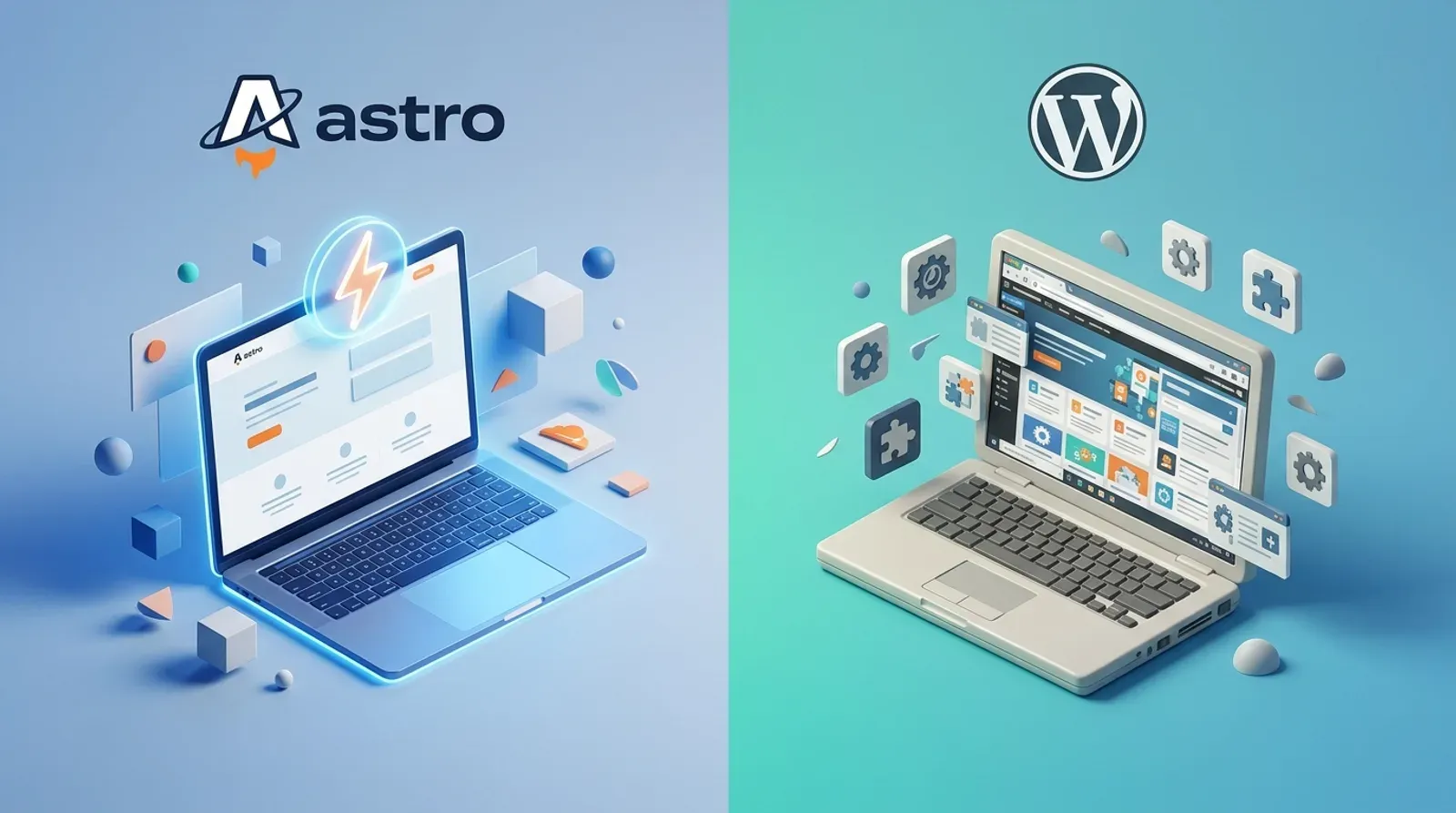
The platform is the biggest lever on the total cost of a website. A website builder, WordPress, a static site on Astro and Shopify each have a different cost profile: one pushes the build price down but raises the recurring cost, another asks more up front but stays cheap afterwards.
| Platform | Build cost | Recurring cost | Cost profile over time |
|---|---|---|---|
| Website builder (Wix, Squarespace) | Low | Fixed subscription, ongoing | Rises through subscription and lock-in |
| WordPress | Low to medium | Hosting, plugins, security, maintenance | Rises through maintenance and security |
| Static site (Astro) | Medium | Low hosting cost, little maintenance | Low and predictable |
| Shopify | Medium | Platform and app subscriptions | Justified for a real webshop |
Website builders like Wix and Squarespace have a low entry point, but you pay an ongoing subscription and are locked into the platform. WordPress is flexible and cheap to start, but the sum of hosting, premium plugins, security and maintenance adds up over three years. A static site on Astro asks a little more development work up front, but then runs at a low, predictable hosting cost with little maintenance. For real webshops with many products, stock and checkout, Shopify remains the right choice, even though the cost profile is higher. What that webshop side costs in total, from licence to payment fees per sale, is fully covered in what a webshop costs.
If you are unsure which platform suits your budget and goals, an honest scoping exercise up front pays off more than a quick choice for the cheapest or the most expensive option. ClickForest reviews which approach fits in a no-obligation introductory call, without automatically pointing to the heaviest platform. Building a website starts with the right foundation, not with the lowest or the highest figure.
What does a cheap website cost you in the long run?
A cheap website often carries a higher total cost through weaker performance, security risks and missed conversion. The saving on the build disappears if the site loads slowly, inspires little trust or is expensive to maintain. Cheap at the start is not the same as economical over the lifespan.
Visual quality is no detail here. The Stanford Web Credibility study shows that 46.1% of visitors judge the credibility of a site primarily on its visual design. A cheap, generic design therefore directly costs leads, because visitors drop off before they read your offer.
“Good design is good business.”
— Thomas J. Watson Jr., former CEO of IBM
That insight is not new, but it weighs more heavily as visitors judge faster. A considered design earns itself back through higher conversion, while a cheap build that saves on usability does the opposite.
“The average business metrics improvement after a usability redesign is now 83%.”
— Jakob Nielsen, founder of Nielsen Norman Group (2008)
The cheapest option is therefore rarely the most profitable. A website audit reveals where an existing site loses conversion or trust, before you invest in a new one.
How does the cost compare to what a website delivers?
A website is an investment you weigh against leads, conversion and revenue, not against the lowest price. Speed and design translate directly into commercial results: a faster, more credible site converts better and therefore delivers more than the extra build cost amounts to.
The figures are consistent. Deloitte measured for Google that a 0.1 second faster mobile load time raises retail conversion by 8.4% and average order value by 9.2%. Conversely, according to Google (2016), 53% of mobile visitors abandon a page once it takes longer than three seconds to load. Speed is therefore not a technical detail but a conversion lever, and that is precisely where cheap sites tend to fall short.
Design weighs on the figures too. McKinsey tracked 300 companies and found that the design-driven leaders achieved 32 percentage points more revenue growth and 56 percentage points more growth in total returns to shareholders over five years than their industry peers.
“This isn’t a linear game, and it’s not a case where one extra dollar spent on design leads to one extra dollar of revenue. It is a case of disproportionate rewards.”
— Benedict Sheppard, partner at McKinsey
Anyone who weighs the cost of a website against the conversion optimisation it delivers is looking at return rather than expense. That is the core of the TCO reasoning: it is not the lowest price that counts, but the best ratio between investment and return.
How do you set a realistic budget for your website?
A realistic budget starts from the scope, not from a figure floating around. First define the goal and the must-have functionality, think in total cost over three years, then request a custom quote. Judge it on the ratio between investment and result, not on the lowest build price.
Concretely, you go through four steps. One: set the goal, for example leads, sales or authority, and determine which functionality is really needed for it. Two: count the recurring costs, not just the build. Three: request a scope-based quote in which pages, functionality and timeline are clearly stated. Four: be wary of a fixed price given without any scope, because it hides assumptions.
ClickForest puts together every website project for SMEs and scale-ups in Flanders based on an agreed scope, with attention to the total cost. Those who first want to know where an existing site stands can turn to a website audit or an introductory call. That way the budget becomes a deliberate choice rather than a gamble.
Conclusion
What a website costs depends on the scope and weighs most heavily over the full lifespan, not just at the build. The price is a function of pages, design, functionality and platform, and the recurring costs for hosting, maintenance and security co-determine whether a low build price is really economical.
The smartest question is therefore not what is cheapest, but what this site costs and delivers you over three years. A fast, secure and credible website earns itself back through conversion, while a cheap build that saves on speed or design costs money that is not on the quote.
ClickForest helps SMEs and scale-ups in Mechelen and surroundings build a website that stays economical even after three years, with a no-obligation introductory call as the starting point. Prefer working with someone nearby? Then you can go for website development in Mechelen with a fixed point of contact in the region. That way you pay for the right foundation, not for the lowest figure.

A fast, modern website that works for your business
Considering a new website or a switch to a modern platform? See our website development
Discuss your challenge directly with Frederiek: Book a free strategy call or send us a message
Prefer email? Send your question to frederiek@clickforest.com or call +32 473 84 66 27
Strategy without action remains theory. Let's take your next step together.
Frequently asked questions
At ClickForest a brochure site on Astro starts from €3,995 one-time, followed by a fixed infrastructure cost from €39 per month for hosting and email, which ClickForest invoices yearly in advance. Above that entry point the cost depends on the scope, the platform and the total cost over several years. ClickForest works with SMEs in Flanders on a custom quote after a no-obligation introductory call, with a clear scope and timeline. That way you compare investment against functionality instead of loose figures.
The build cost of a WordPress site is often low, but the total cost rises through hosting, premium plugins, security and maintenance. 91% of WordPress vulnerabilities sit in plugins (Patchstack). So count on the cost over three years, not just the build price.
That depends on the platform and the scale. A WordPress site needs ongoing updates, backups and security work, while a static site on Astro structurally needs less maintenance. Maintenance is a recurring cost you budget for in advance.
Not always, but a low build price often hides a higher total cost through weak performance, security risks and missed conversion. 46.1% of visitors judge credibility on visual design (Stanford). A website is an investment you weigh against leads and conversion, not purely against the lowest price.
A simple brochure site is usually ready in a few weeks, a full business website with a blog and integrations takes longer. ClickForest plans every website project for SMEs in Mechelen and surroundings based on the agreed scope. So the lead time is tied to the chosen functionality.
Sources and references
Speed and conversion:
- Deloitte for Google: "Milliseconds Make Millions" (2020) · https://www.deloitte.com/ie/en/services/consulting/research/milliseconds-make-millions.html
- Marketing Dive / Think with Google: 53% abandon after more than 3 seconds (2016) · https://www.marketingdive.com/news/google-53-of-mobile-users-abandon-sites-that-take-over-3-seconds-to-load/426070/
Design and credibility:
- McKinsey: "The Business Value of Design" (2018) · https://www.mckinsey.com/capabilities/tech-and-ai/our-insights/the-business-value-of-design
- consulting.us: McKinsey on design-driven firms (Benedict Sheppard) · https://www.consulting.us/news/1388/mckinsey-says-design-driven-firms-see-increased-revenues-shareholder-returns
- Stanford Web Credibility Project (Fogg et al., 2002) · https://en.wikipedia.org/wiki/Stanford_Web_Credibility_Project
- Nielsen Norman Group: "Usability ROI Declining, But Still Strong" (2008) · https://www.nngroup.com/articles/usability-roi-declining-but-still-strong/
WordPress security and TCO:
- Patchstack: "State of WordPress Security in 2026" · https://patchstack.com/whitepaper/state-of-wordpress-security-in-2025/
Market context:
- Clutch: Small Business Websites (2025) · https://clutch.co/press-releases/smb-websites-2025
Quotes:
- BrainyQuote: Thomas J. Watson Jr. · https://www.brainyquote.com/quotes/thomas_j_watson_174981