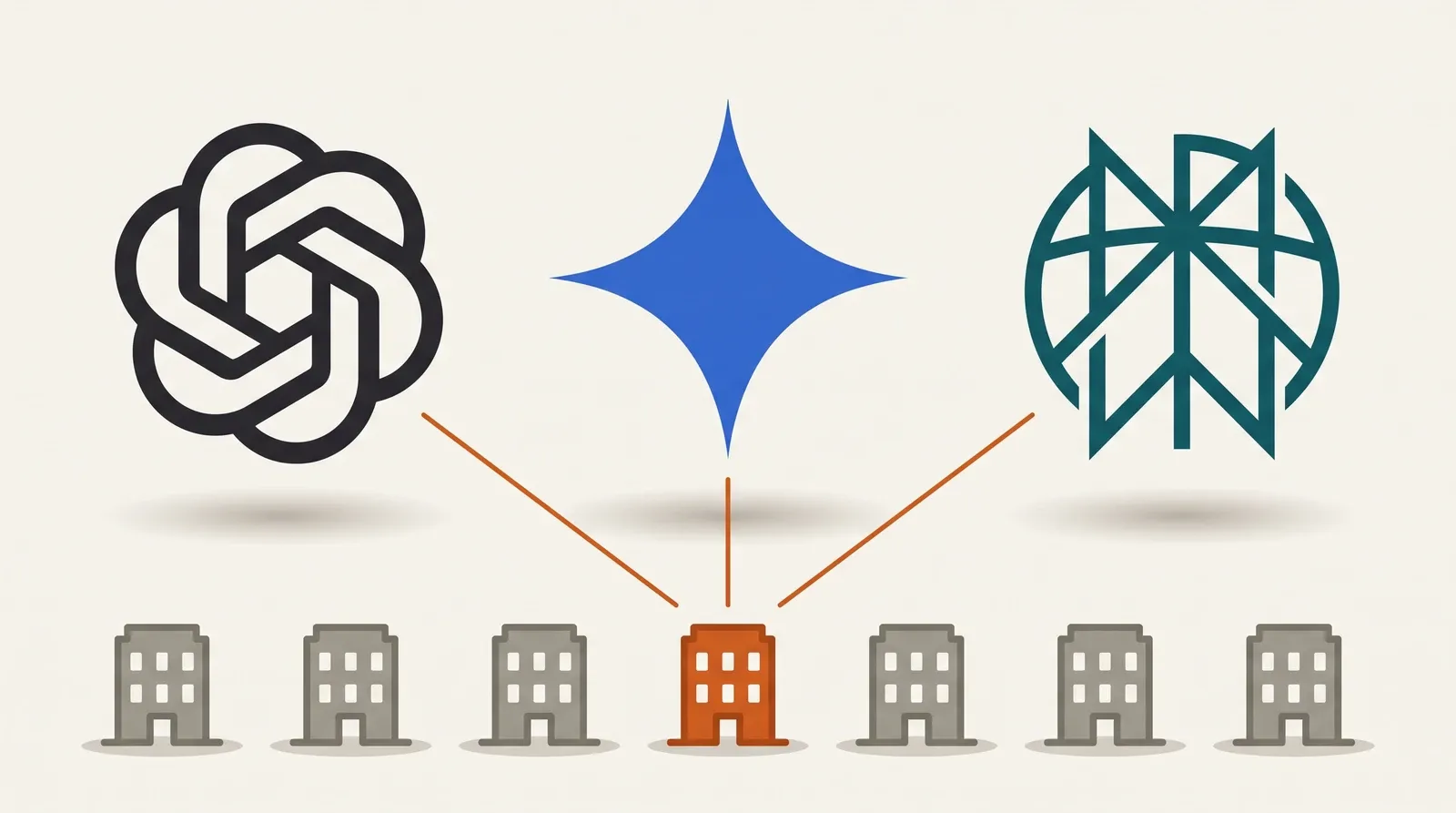
Agentic commerce: how to make your webshop findable for AI agents
Agentic commerce is live. Discover how your Shopify webshop becomes findable for ChatGPT, Perplexity and Google. Practical checklist for Belgian SMEs.


Summary
- Agentic commerce went live in Q4 2025 in the US: ChatGPT, Perplexity and Google allow consumers to purchase directly within AI conversations
- Shopify Agentic Storefronts is available today: with one click you syndicate your products to ChatGPT, Perplexity and Microsoft Copilot
- AI agents compare on data, not design: "100% organic cotton, 200 GSM" beats "delightfully soft"
- Structured data is the new foundation: JSON-LD for Product, Offer and AggregateRating determines whether an AI agent recommends you or not
- Europe follows in 12 to 24 months: PSD3 and Bancontact integration delay autonomous AI purchases in the Benelux, but preparation starts now
- Bain estimates 25% of e-commerce via AI agents by 2030: those who lay the data foundations now build an advantage that is hard to catch up with
Adobe Analytics registered a growth of 4,700% in traffic from generative AI to American webshops in July 2025, compared to the same month a year earlier. Salesforce reported that AI and agents influenced 20% of all orders globally during Cyber Week 2025 via personalised recommendations and customer service. And in 2025, OpenAI launched a shopping feature that allows people to order products directly in ChatGPT, without ever visiting your website.
This is not science fiction. The customer journey is already changing today, and for Belgian webshops it pays to position yourself now, before the rest catches on.
What is agentic commerce and why is it relevant for your webshop?
Agentic commerce is the model in which an AI agent such as ChatGPT, Perplexity or Google Gemini independently searches for, compares and purchases products on behalf of a user. The consumer gives instructions (“find the best leather backpack under 150 euros”), the agent does the rest.
The fundamental difference from classic online shopping: the AI does not go to your webshop to browse. It retrieves information from structured product data, feeds and APIs. Those who do not offer machine-readable data simply do not exist in that channel.
GEO optimisation, being findable in AI search engines, lays exactly the same technical foundation as agentic commerce. It is not a separate track, it is the same investment with a broader return, and it starts with the technical SEO foundation of your Shopify webshop.
Which AI platforms are already live for e-commerce?
In the final months of 2025, four concrete platforms were launched that fundamentally change the customer journey.
ChatGPT shopping: OpenAI launched a shopping feature in 2025 that allows Shopify and other merchants to make their products purchasable within ChatGPT conversations. The integration runs through existing checkout infrastructure.
Perplexity Instant Buy (November 2025): via a partnership with PayPal, merchants can sell products from Perplexity search queries. Users pay without leaving the search interface.
Google Agentic Checkout (November 2025): Google Pay detects price drops and can complete purchases for products users have previously saved.
Amazon Rufus: already active for longer and processes hundreds of millions of search queries per month. It is the largest-scale AI shopping platform in the world.
“Sell your products wherever AI conversations happen, not just in your own store, but also in the AI tools your customers already use daily.”
— Shopify, Winter ‘26 Edition
Is Shopify already ready for agentic commerce?
Yes, and further along than most merchants realise. With the Winter ‘26 Edition (December 2025), Shopify launched three concrete tools.
Agentic Storefronts: a one-click setup that automatically distributes your product catalogue to ChatGPT, Perplexity and Microsoft Copilot. After activation, an MCP endpoint automatically runs for your store.
Catalog API: AI agents gain access to your complete product data via a standardised interface, including prices, stock, specifications and returns policy. Real-time and machine-readable.
ChatGPT checkout integration: Shopify products are directly purchasable from ChatGPT without the buyer leaving the chat interface.
An important nuance: Shopify Sidekick is something different. Sidekick is a management tool that helps you as a retailer via AI, for sales analyses, automations and content generation. It is not a shopping agent for consumers. This confusion regularly leads to wrong expectations.
Want to know more about how your Shopify webshop performs optimally? Check out our page on conversion optimisation.
How do AI agents compare products and what does that mean for your data?
| Characteristic | Classic (2023) | Agentic commerce (2026) |
|---|---|---|
| Starting point | Google search query | AI prompt |
| How decisions are made | Human compares visually | AI compares data |
| Number of steps | 10 to 14 clicks | 1 to 2 confirmations |
| Visit to webshop | Required | Optional to absent |
| What convinces | Design, UX, copy | Data, specs, reviews |
| Payment | On webshop | In AI interface |
AI agents do not read product pages like humans. They extract structured data, weigh it against user criteria and make a decision in milliseconds. Vague marketing texts are ignored; specifications are compared.
Research by Semrush showed that a large portion of ChatGPT’s product recommendations overlaps with Google Shopping results. This has direct implications: your Google Shopping feed is now also your AI visibility feed. Those who do not have their feed in order will be missed in both channels.
Three factors determine whether an AI agent recommends you.
Data quality: specific, factual product descriptions with measurable properties. “300 GSM organic cotton, EU Ecolabel certified” beats “premium quality”.
Structured data: JSON-LD schemas for Product, Offer, AggregateRating and MerchantReturnPolicy tell AI systems exactly what you offer, at what price and under what conditions.
Reputation signals: AI agents weigh reviews from multiple sources. A low or missing review score means the agent does not even suggest you, regardless of price or quality.
What are the 5 steps to make your webshop AI-proof today?
This is what you as a Belgian webshop owner can concretely do, without overhauling your entire architecture.
1. Implement structured data Add JSON-LD schemas for Product, Offer, AggregateRating and MerchantReturnPolicy. These are the fields AI agents consult first. On Shopify this can be done via apps such as Schema Plus or via adjustments in your theme. Read more about structured data and Google to understand which schemas take priority. SEO and GEO share the same data foundations: what is good for Google is good for AI agents.
2. Optimise your Google Shopping feed Ensure your Shopping feed is up to date, contains accurate titles with product specifications and includes GTIN/EAN codes. What is here is also read by AI agents. This is not an extra task; it is the same feed you should already be optimising for your performance marketing campaigns.
3. Rewrite product descriptions factually Replace vague qualifications with measurable specifications. Not “superior high-quality leather” but “full-grain cowhide, 1.8 mm thickness, tanned without chrome salt.” AI agents can compare that; marketing language cannot.
4. Activate Shopify Agentic Storefronts If you are on Shopify: go to your Admin, find Agentic Storefronts via the Winter ‘26 Edition updates and activate it. It takes minutes and automatically distributes your products to ChatGPT and Perplexity. More about the possibilities of Shopify for Belgian merchants. Not yet on Shopify? Check out our startup and migration page.
5. Structure FAQ, shipping policy and returns policy to be machine-readable AI agents check returns policy and shipping costs before recommending a product. Make sure that information is clear, complete and structured on your site, not buried in a PDF or image. This connects directly to your AI chatbot for consistent customer service, and to a solid maintenance and support contract to keep your Shopify environment up to date.
“Agentic AI could account for approximately 25% of American e-commerce revenue by 2030, fundamentally changing how consumers discover and purchase products online.”
— Bain & Company, e-commerce and AI agents research report 2025
What does a Belgian SME not yet need to do?
The hype around agentic commerce gives the impression that every webshop must overhaul its entire architecture tomorrow. That is not the case.
Building your own AI agents: platforms such as Shopify, Mollie and Stripe are building the transaction infrastructure. You supply the data foundations. A custom AI agent for purchases is an enterprise solution that most Belgian SMEs do not yet need.
Developing MCP servers yourself: if you are on Shopify, you already have one. Shopify automatically generates an MCP endpoint for every store via the Winter ‘26 API updates.
Adding an llms.txt file: this protocol has limited adoption and no official support from major LLM providers. Google’s John Mueller confirmed that AI services do not in practice consult this file. Direct your first attention to structured data.
For those who want to know how marketing automation or custom AI agents connect to this evolution: the patterns are comparable. Also compare how GEO evolved relative to SEO: the foundations are the same, the application shifts gradually. Those who have the basics in order follow the evolution effortlessly.
When is agentic commerce coming to Europe and Belgium?
The current platforms are all active in the US. The European rollout is delayed for concrete reasons: PSD3 regulation, Strong Customer Authentication requirements and the fragmented payments market with Bancontact, iDEAL and SOFORT.
Mollie, active in the Benelux, confirms in their agentic commerce FAQ that the payment infrastructure for Europe is in active development and will go live for selected merchants in 2026.
“The infrastructure for agentic payments is live in the US and is actively being built out for European markets. PSD3 compliance and local payment methods such as Bancontact and iDEAL are our priority for the European rollout.”
Mollie, Agentic Commerce & European Payments FAQ Source: mollie.com/growth/agentic-commerce-european-payments-faq
The realistic timeline for Belgian merchants: 12 to 24 months for a broad rollout of autonomous AI purchases. But the preparation time is now. Those who wait until it goes live start a year too late and miss the first-mover advantage in AI search citations.
Also check our analysis of zero-click and its importance for Belgian webshops, because agentic commerce significantly accelerates that trend.
“In agentic commerce, the winner is not the brand with the biggest advertising budget or the most beautiful landing page. It is the merchant with the most accurate, structured and reliable product data — because that is what AI agents can actually assess.”
— Kevin Indig, Growth Memo
Why is GEO optimisation the bridge to agentic commerce?
The technical foundation for agentic commerce is the same as that for GEO optimisation: structured data, machine-readable content, factual product information and strong reputation signals. Those who implement GEO correctly automatically lay the groundwork for agentic commerce.
Concretely: the structured data that an AI search engine uses to cite you in an answer is exactly the same data that an AI agent needs to recommend your product. One investment, two direct returns.
At ClickForest we combine GEO strategies with online marketing and e-commerce optimisation. We help Shopify merchants structure their product data and content so that both traditional search engines and AI platforms correctly understand and recommend them. More about our approach via AI for growth.
Ready to make your webshop findable for AI agents?
We check your structured data, Shopping feed and GEO optimisation and give you a concrete action plan. Request a website audit or schedule a video call, no obligations, direct answer from Frederiek.

Your brand visible in ChatGPT, Perplexity and other AI search engines
Want to know if your brand gets mentioned when people search with AI tools? Our GEO services
Discuss your challenge directly with Frederiek: Book a free strategy call or send us a message
Prefer email? Send your question to frederiek@clickforest.com or call +32 473 84 66 27
Strategy without action remains theory. Let's take your next step together.
Frequently asked questions
Agentic commerce is the model in which an AI agent such as ChatGPT, Perplexity or Google Gemini independently searches for, compares and purchases products on behalf of a user. The consumer gives instructions, the AI agent conducts the research and completes the purchase. The buyer does not necessarily visit the seller's webshop.
Fully autonomous AI purchases are currently limited to the US. The expected rollout for Europe is 12 to 24 months, depending on PSD3 compliance and integration with Benelux payment methods such as Bancontact.
Shopify Sidekick is a management tool for merchants: it helps you run your webshop via AI prompts, for sales analyses, automations and content generation. Agentic Storefronts goes the other way: it makes your products available to AI agents shopping on behalf of consumers. Both are relevant, but for agentic commerce, Agentic Storefronts is the most directly applicable.
Go to your Shopify Admin and navigate to the Winter '26 Edition update settings. The Agentic Storefronts option is available via the Sales Channels section. After activation, Shopify automatically generates an MCP endpoint for your store and distributes your product catalogue to ChatGPT, Perplexity and Microsoft Copilot. Exact availability depends on your Shopify plan and region.
Structured data is encoded product information in JSON-LD format that search engines and AI systems can read directly. Where a human visually scans your product page, an AI agent processes the structured layer: price, availability, specifications, review score and returns policy. If that layer is missing, your product simply does not exist in the AI channel. The most relevant schemas are Product, Offer, AggregateRating and MerchantReturnPolicy.
No, that is not a priority. The llms.txt protocol has limited adoption and no official support from major LLM providers. Direct your first attention to structured data, Shopping feed quality and factual product descriptions.
GEO optimisation focuses on being findable in AI search engines such as ChatGPT and Perplexity. Agentic commerce goes a step further: not only being found, but also being the endpoint of an AI-driven purchase. The technical foundation is identical. Those who implement GEO correctly automatically lay the groundwork for agentic commerce.
Replace vague statements with measurable specifications. "High quality" means nothing to an AI agent; "1.4 mm full-grain leather, 300 GSM, water-repellent coating" can be compared. Always include: material composition, dimensions, weight, certifications, compatibility and usage instructions.
Most changes are work, not software purchases. Implementing structured data via JSON-LD is a one-time technical investment. Optimising your Shopping feed can be done via your existing Google Merchant Center account. For Shopify merchants, Agentic Storefronts is included in existing plans. For an average Belgian webshop, I estimate the initial implementation at 2 to 5 working days, depending on catalogue size.
Test this manually: search in ChatGPT, Perplexity and Google Gemini for your product category plus niche. Do you appear? Then use a website audit to check which structured data is missing. At ClickForest we track LLM visibility for Belgian businesses via SEranking.
Yes, perhaps even more so than for B2C. Buyers in B2B are increasingly delegating comparison work to AI assistants. "Find the three best suppliers of industrial stainless steel with CE certification and delivery within 48 hours in Belgium" is exactly the type of assignment a professional buyer gives an AI agent. Structured data with technical specifications, certifications and delivery terms are decisive in B2B.
Sources and references
Agentic commerce and AI platforms:
- OpenAI – ChatGPT shopping and checkout · https://openai.com/index/buy-it-in-chatgpt/
- Shopify – Introducing Shopify Agentic Storefronts (Winter '26 Edition) · https://www.shopify.com/news/winter-26-edition-agentic-storefronts
- CNBC – Perplexity announces free product to streamline online shopping · https://www.cnbc.com/2025/11/19/perplexity-ai-online-shopping-paypal.html
- Google Blog – Google Shopping launches agentic checkout and more AI shopping tools · https://blog.google/products-and-platforms/products/shopping/agentic-checkout-holiday-ai-shopping/
Market data and research:
- Adobe Analytics – Generative AI-powered shopping rises with traffic to U.S. retail sites · https://business.adobe.com/blog/generative-ai-powered-shopping-rises-with-traffic-to-retail-sites
- Salesforce – AI and Agents Propel Cyber Week to Record $336.6B in Global Spend · https://www.salesforce.com/
- Digital Commerce 360 – Bain: Agentic AI could account for 25% of U.S. ecommerce sales by 2030 · https://www.digitalcommerce360.com/2025/12/22/bain-agentic-ai-us-ecommerce-sales-2030/
Strategy and implementation:
- Mollie – Agentic Commerce: Your European Strategy & Payments FAQ · https://www.mollie.com/growth/agentic-commerce-european-payments-faq
- Growth Memo – How do you compete in agentic commerce? · https://www.growth-memo.com/p/how-do-you-compete-in-agentic-commerce
- Shopify Developers – Agentic commerce documentation · https://shopify.dev/docs/agents